
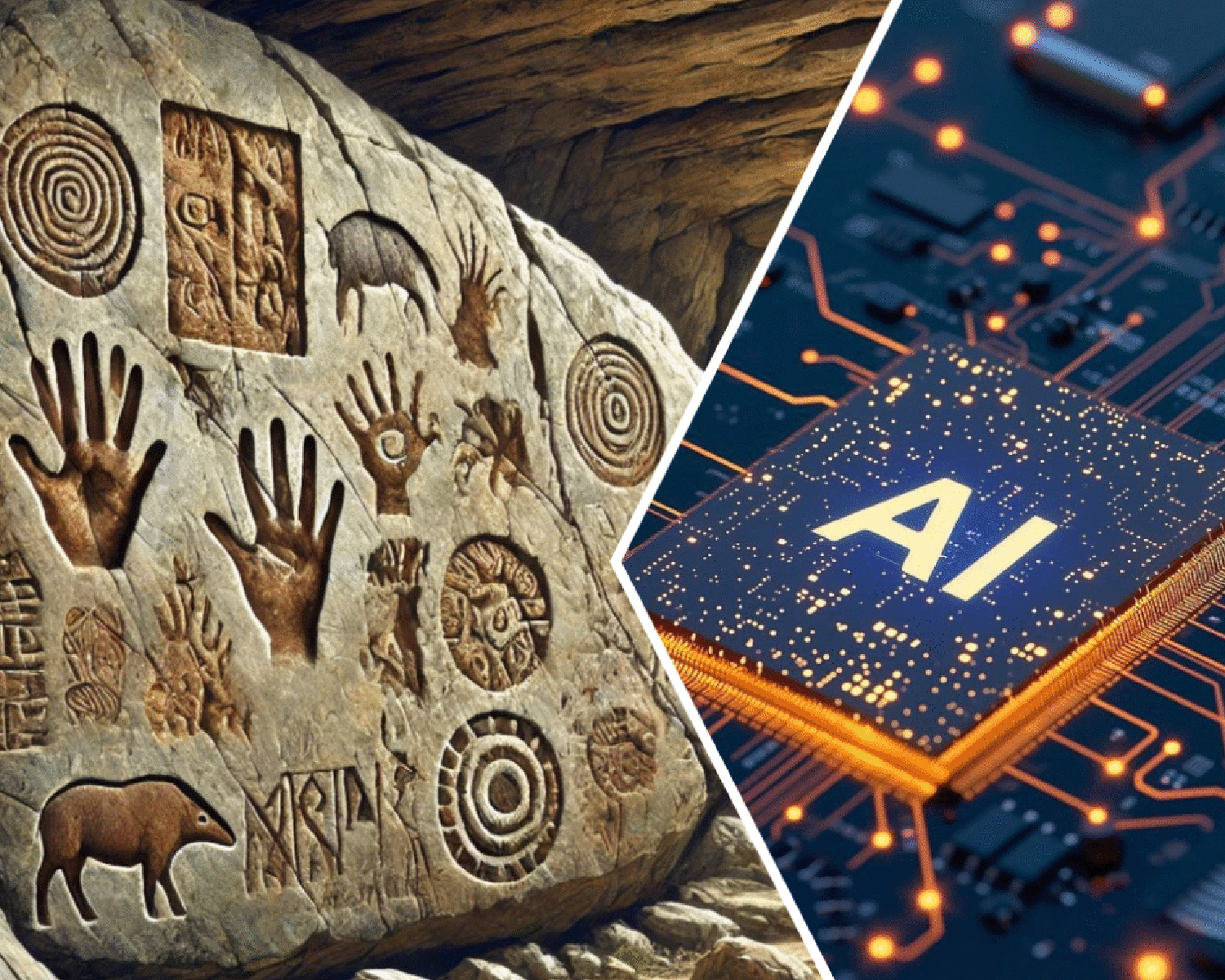
Human history is, in many ways, the story of our relationship with information. From the first cave paintings that captured the hunt on stone walls to today’s algorithms predicting our every move, we have been both the creators and the consumers of knowledge. Yet, as Artificial Intelligence (AI) takes center stage, a new question emerges: have we mastered information, or have we become its slaves?
In the Stone Age, information was survival. Humans carved knowledge into rocks, passed wisdom through oral traditions, and learned from nature through direct experience. Information was slow, deliberate, and scarce. Each discovery; fire, tools, shelter carried profound meaning and required deep observation. Knowledge was sacred because it was hard-earned. The hunter knew his terrain, the tribes remembered their stories, and learning was a matter of life and death. Humanity was not overloaded with information; rather, it was shaped by it in the purest sense.
Then came the Agricultural and Industrial Ages, which changed everything. The ability to record, store, and share information accelerated exponentially. From clay tablets to the printing press, information began to multiply. The printing press in particular marked a historic shift by democratizing the knowledge. For the first time, information was no longer controlled by a few; it began to belong to many. Yet with this power came the first signs of what would later become information anxiety. The more we knew, the more we realized how much we didn’t know.
Fast forward to the Digital Age. The 20th century introduced computers, the internet, and the concept of data as power. Information became currency. Those who could control it; corporations, governments, and media giants held influence over societies. We built systems capable of storing every click, every conversation, every transaction. Human progress reached unprecedented heights, but something subtle began to shift. The flow of information, once a tool, became a torrent, fast, endless, and often uncontrollable.
Now, in the Age of Artificial Intelligence, information has evolved into something living a system that learns, adapts, and acts without our constant supervision. AI does not just store data; it interprets it, predicts it, and sometimes manipulates it. From search engines suggesting what we should read, to social media algorithms shaping what we should believe, the boundaries between human choice and machine suggestion have blurred.
So, are we slaves or masters of information? The answer, uncomfortably, might be both.
We are masters because never before in history have humans had such access to knowledge. A student in a remote village can learn quantum physics on YouTube. A doctor can diagnose diseases through AI-driven imaging. Entrepreneurs can build global businesses from a laptop. We command oceans of data, connect across continents, and innovate faster than any generation before us. Information has become the ultimate equalizer, empowering those who seek it and democratizing opportunity.
Yet, at the same time, we are slaves, not to information itself, but to its overwhelming abundance and the systems that control it. Our phones dictate our routines, notifications interrupt our focus, and social media feeds condition our emotions. We scroll more than we reflect. Algorithms know our preferences better than our families do. The digital world rewards immediacy over insight, reaction over reflection. In seeking convenience, we have surrendered control.
The irony is profound: in the Stone Age, we carved symbols into rocks to preserve memory. Today, machines carve our memories into code. We once mastered tools; now tools master our attention. We once sought knowledge to become wiser; now we consume information to stay relevant. The medium has changed, the message, however, remains the same: humanity’s survival depends on how responsibly we handle knowledge.
The path forward demands digital consciousness, the ability to use technology without losing ourselves to it. We must learn to pause, question, and filter. Education systems need to move beyond rote information toward cultivating judgment, ethics, and emotional intelligence. Corporations must prioritize transparency over manipulation. And as individuals, we must reclaim our curiosity not just to consume, but to understand.
Being the master of information in the AI era doesn’t mean controlling every byte of data. It means controlling how we engage with it. It means recognizing bias, respecting privacy, and valuing depth over volume. It means using AI as a partner not a replacement in our quest for knowledge.
From the Stone Age to AI, humanity’s journey with information has always been a reflection of its own evolution from instinct to intelligence, from survival to strategy whether we end up as slaves or masters, will depend not on how advanced our machines become, but on how wise we remain as the real intelligence was never artificial it was human.


